Explainer
Why do bond prices fall when interest rates rise?
Bond prices fall when interest rates rise because an existing bond's interest payment is fixed. When new bonds pay more, an older bond only sells at a discount. This is why US Treasury bonds lost value as the 10-year yield (the yearly return on a US government bond repaid in ten years) climbed to 5.31% on October 5, 2026, according to the U.S. Treasury's daily interest rate data. Our guide to bond yields covers the bigger picture.
How does a fixed payment make the price move?
Think of a bond as a promise: "Lend me $1,000 today and I will pay you $40 a year, then give you your $1,000 back at the end." The $40 never changes. Only the price someone will pay for that promise can change.
If interest rates rise so that new $1,000 bonds pay $50 a year, the old bond paying $40 looks worse. A buyer will still take it, but only for less than $1,000. The lower price makes up for the smaller payments.
Why do long-term bonds fall the most?
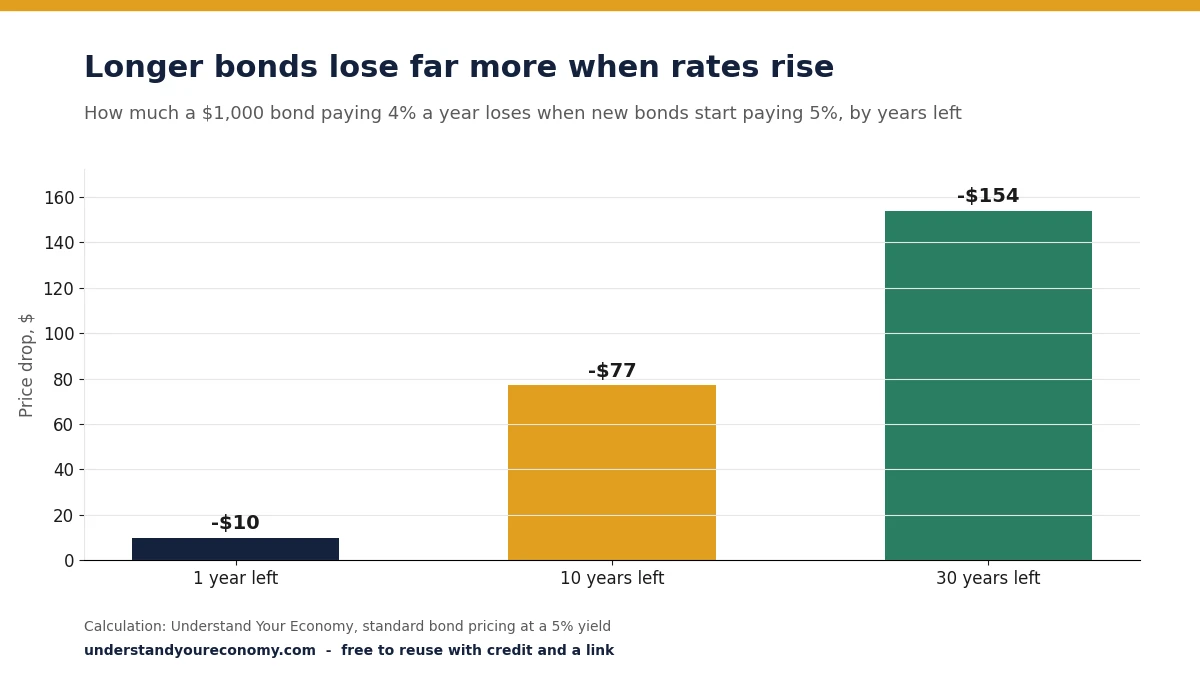
The longer you are locked into a lower payment, the more that gap costs you. A 1-year bond is repaid soon, so its owner can reinvest at the new, higher rate within months. A 30-year bond's owner is stuck for decades. That sensitivity to rate changes is called duration: the longer the duration, the bigger the price swing.
What this means for you
- If you hold a bond to the end, you still get your money back. The price only matters if you sell before then. The US government repays its bonds in full at maturity.
- Bond funds feel it right away. A fund holds many bonds and is valued at today's prices, so its value drops when yields rise. Funds that hold longer bonds drop more.
- Rising yields help new buyers. Anyone buying a bond today locks in the higher payment.
For what higher yields mean for mortgages and the government's budget, see our guide to bond yields. To follow the 10-year yield itself, see our 10-year Treasury yield page.
Researched from the official sources linked in this article and drafted with AI assistance. Fact-checked by the Understand Your Economy editorial team on October 15, 2026.
This article is general educational information, not personalised financial, investment, tax or legal advice. Consider speaking with a qualified professional about your own situation.
No paid links in this article.
Spotted an error? Tell us and we will correct it.