In depth · US vs Canada
Bond yields explained: what they are and why they matter
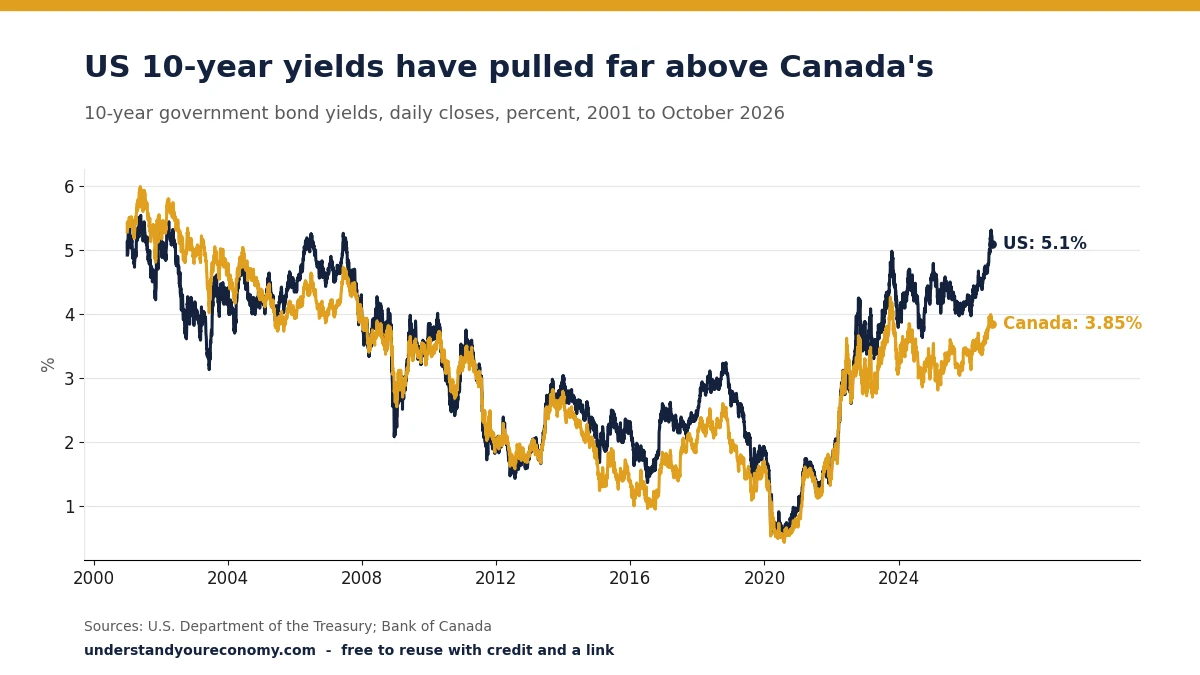
A bond yield is the yearly return a lender earns for lending money to a government or company, shown as a percentage. On October 15, 2026 the US 10-year Treasury bond closed at a yield of 5.1%, according to the U.S. Treasury's daily yield curve data. That is close to its highest level since 2002, and it matters because mortgage rates, savings rates and government budgets all follow it.
What is a bond yield?
A bond is a loan you can buy and sell. The borrower, such as the US government, promises to pay a fixed amount of interest each year and to repay the full amount on a set date, called the maturity. The yield is the return you actually get once you account for the price you paid.
When people say "the 10-year yield", they mean the return on US government bonds that are repaid in ten years. Investors watch it more than any other number in the bond market because so many other loans are priced off it. For a step-by-step look at the price side, see why bond prices fall when interest rates rise.
Why do bond prices and yields move in opposite directions?
A bond's interest payment is fixed when it is sold. If new bonds start paying more, nobody will pay full price for an old bond that pays less. Its price drops until its yield matches the new, higher rate. So when yields go up, the prices of existing bonds go down, and the other way around.
That is why a rise in yields hurts people who already own bonds, and helps people buying new ones.
Why does the 10-year Treasury yield matter?
The 10-year yield is the starting point for most long-term borrowing in the United States. The clearest example is the 30-year fixed mortgage. Freddie Mac's weekly survey put the average 30-year mortgage rate at 7.40% in the week of October 8, 2026, the highest since November 2023, according to Freddie Mac's Primary Mortgage Market Survey. In late August 2026 it was 6.66%.
It matters for the government too. The US paid $1,143 billion in net interest on the public debt in fiscal year 2026, more than the $916 billion it spent on the military, according to the Congressional Budget Office's preliminary September 2026 review. That works out to about 21 cents of every dollar of federal revenue in fiscal year 2026.
What is pushing yields up?
Three forces have pushed US yields higher in 2026:
- Inflation. US consumer prices rose 3.7% in the 12 months to September 2026, led by gasoline, according to the Bureau of Labor Statistics. Lenders want a higher return when inflation eats into what they get back.
- The Federal Reserve. On September 16, 2026 the Fed raised its target range for short-term interest rates to 3.75-4.00%, its central lever on borrowing costs, according to the Federal Reserve's statement.
- Government borrowing. The US ran a deficit of about $1,993 billion in fiscal year 2026, according to the Congressional Budget Office. More borrowing means more bonds for investors to absorb.
The 10-year yield first closed at 5% on September 15, 2026 and peaked at 5.31% on October 5, 2026, its highest close since May 2002, based on the U.S. Treasury's daily yield curve data.
How do US and Canadian yields compare?
| United States | Canada | |
|---|---|---|
| 10-year yield, close on October 14, 2026 | 5.19% | 3.85% |
| Gap | 1.34 points higher in the US |
Sources: U.S. Treasury daily yield curve and Bank of Canada bond yields, October 14, 2026.
In the early 2000s Canada's 10-year yield was the higher of the two, and for long stretches since then they moved closely together. Since 2024 the US yield has stayed roughly a full percentage point above Canada's, so the US government now pays well over a point more to borrow for ten years. The two numbers are measured slightly differently: the US figure is the Treasury's constant-maturity yield, while Canada's is the Bank of Canada's 10-year benchmark bond yield. Both show what each government pays to borrow for ten years.
What this means for you
- Borrowing costs more. Higher bond yields feed into mortgages, car loans and lines of credit, so new loans cost more than they did a year ago.
- Saving can pay more. Higher yields tend to lift the rates offered on new government bonds, certificates of deposit and GICs.
- Existing bonds lose value when yields rise. Bond funds hold older bonds, so their prices fall when yields climb.
Yields change every trading day. We track the latest close on our 10-year Treasury yield page.
Researched from the official sources linked in this article and drafted with AI assistance. Fact-checked by the Understand Your Economy editorial team on October 15, 2026.
This article is general educational information, not personalised financial, investment, tax or legal advice. Consider speaking with a qualified professional about your own situation.
No paid links in this article.
Spotted an error? Tell us and we will correct it.