Explainer
Can you get unemployment if you quit or get fired?
- Can you get unemployment if you quit? Usually not: leaving a job without good cause is one of the most common reasons claims are denied, according to the U.S. Department of Labor.
- Being fired blocks benefits only for misconduct, an act against the employer's interests done on purpose; a layoff for lack of work is the standard case that qualifies.
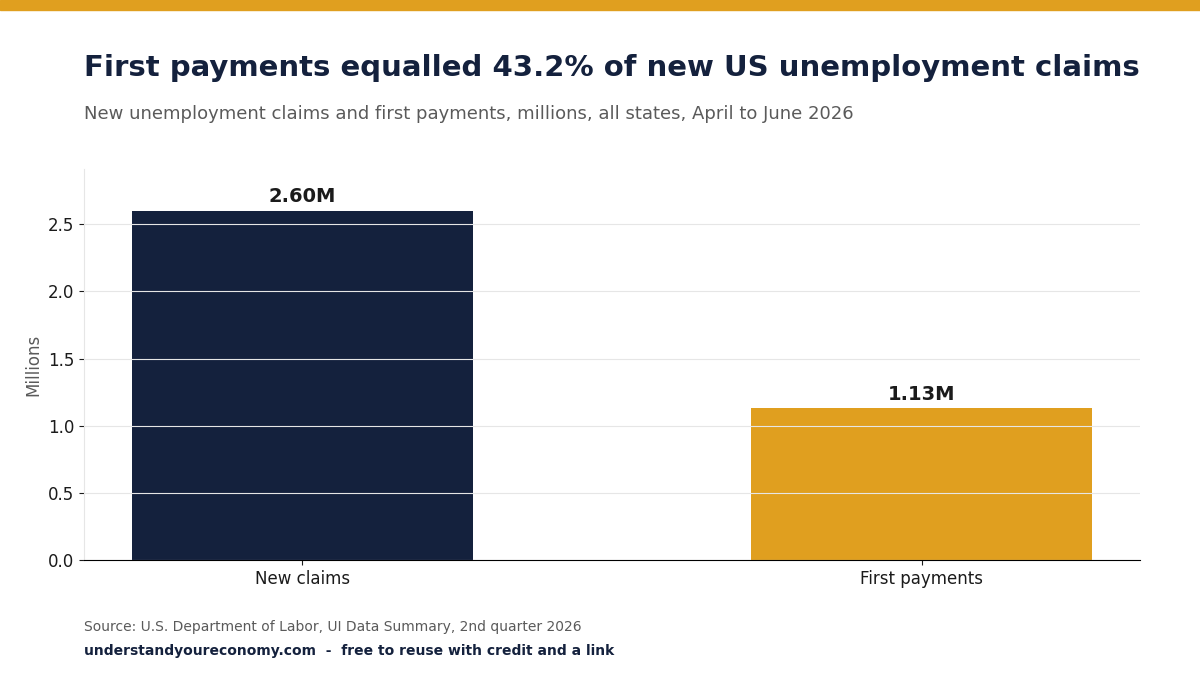
- In April to June 2026, first payments equalled 43.2% of new US claims, by our calculation from Labor Department data; the data do not say how many of the rest were denied.
Can you get unemployment if you quit? Usually not. Quitting without good cause and being fired for misconduct are two of the most common reasons claims are denied, according to the U.S. Department of Labor. Each state decides what counts as good cause. A layoff for lack of work generally qualifies. Canada's EI uses the same test, called just cause. Here is how unemployment works overall.
Why does quitting usually disqualify you?
Because the program is meant for people who are out of work through no fault of their own. The Department of Labor describes benefits as temporary help for workers in that position, and in most states that means people let go because there was not enough work.
The exception is good cause. Each state sets its own extra eligibility rules, the Labor Department notes, so what counts as good cause differs from state to state.
Can you get unemployment if you get fired?
Often, yes. Being fired does not by itself block benefits. What blocks them is misconduct. The Department of Labor defines it as something you did, or failed to do, on purpose or within your control, that shows "a deliberate disregard of the employer's interests". Being bad at the job is not the same thing as choosing to act against it.
What are the other reasons claims get denied?
The Department of Labor's fact sheet lists these common reasons, beyond quitting and misconduct:
- Not able to work or not available for work.
- Not actively looking for work in a week you claimed benefits.
- Turning down suitable work you were offered.
- Making false statements to get benefits.
The able, available and looking tests apply to every week you claim, not just the first, according to the same fact sheet, and each weekly claim must report any job offer you turned down.
Can you appeal a denial?
Yes. You have the right to appeal if your claim is denied, and your former employer can also appeal if benefits are approved, according to the Department of Labor.
How many claims lead to a payment?
Fewer than half. In April to June 2026, 2,604,729 new unemployment claims were filed across the US and 1,125,223 first payments were made, according to Labor Department data. First payments equalled 43.2% of new claims, by our calculation. The data do not say why the rest got no payment, so this is not a denial rate. The share of all unemployed people who collect is lower still, as our page on how unemployment works shows.
Can you get EI if you quit in Canada?
Not without just cause. You are not eligible for regular EI if you quit without just cause, were fired for misconduct, or took a direct part in a labour dispute, according to the Government of Canada. You also need to have lost the job through no fault of your own and to have worked enough insurable hours: 420 to 700 in the last 52 weeks in 2026.
One temporary rule helps people who changed jobs. For claims from October 11, 2026 to October 9, 2027, Service Canada reviews only the most recent job separation, according to the Government of Canada's temporary measures. An earlier job that you quit is not looked at during that period.
| Situation | US | Canada |
|---|---|---|
| Laid off, lack of work | Qualifies | Qualifies |
| Quit | Denied without good cause | Denied without just cause |
| Fired for misconduct | Denied | Denied |
| Fired, no misconduct | Generally not a bar | Not a bar |
| Who decides | State agency | Service Canada |
| Appeal | You or your employer | Yes |
Sources: U.S. Department of Labor fact sheet, U.S. Department of Labor, unemployment insurance, Government of Canada, EI eligibility, EI temporary measures.
What this means for you
- If in doubt, file. Only the agency can decide whether you had good cause, and filing late can cost you weeks.
- Appeal if you disagree. Both you and your former employer have that right.
- Keep looking for work every week. Even an approved claim can lose a week's payment if you skip the job search. Our page on how much unemployment you will get shows what is at stake.
How we got these numbers
Most figures on this page are published as-is by the agencies linked next to them. These ones are our own calculations from official data, so you can check them:
- First payments equalled 43.2% of new US claimsU.S. Department of Labor, April to June 2026: 2,604,729 initial claims and 1,125,223 first payments. 1,125,223 ÷ 2,604,729 = 0.432, or 43.2%.
We do not adjust the official data, and we make no forecasts of our own.
You are welcome to quote these numbers and charts. Please credit Understand Your Economy and link to this page.
Update log
- : Page created with the U.S. Department of Labor fact sheet, Government of Canada EI rules and Labor Department claims data for April to June 2026.
Have a question about this article?
Ask us privately. We read every question, reply by email, and the best ones become new answers on the site.
Ask a questionResearched from the official sources linked in this article, drafted and fact-checked by the Understand Your Economy editorial team on October 31, 2026.
This article is general educational information, not personalised financial, investment, tax or legal advice. Consider speaking with a qualified professional about your own situation.
No paid links in this article.
Spotted an error? Tell us and we will correct it.