In depth
How does unemployment work? US benefits and Canada's EI
- This is how unemployment benefits work: lose a job through no fault of your own, file a claim, and get part of your past pay each week for a limited time, up to 26 weeks in most US states, according to the U.S. Department of Labor.
- The average US weekly benefit was $500.61 in April to June 2026, and claimants collected for 15.8 weeks on average, according to Labor Department data.
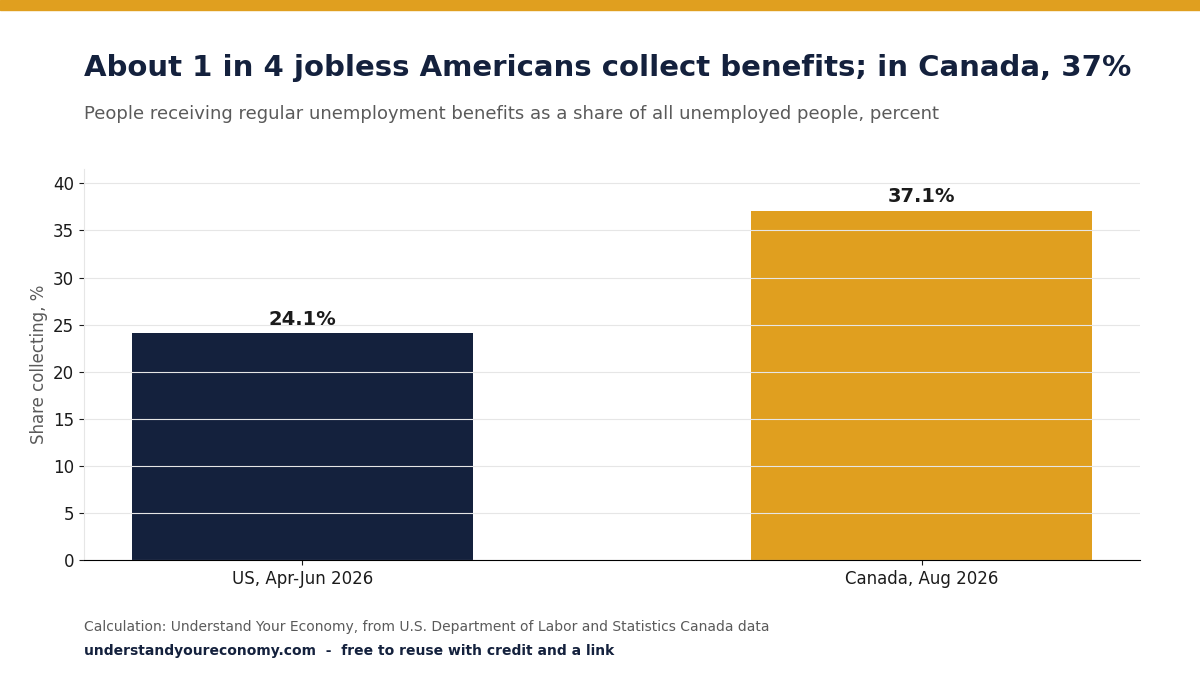
- Only 24.1% of unemployed Americans got regular state benefits in April to June 2026, compared with 37.1% of unemployed Canadians on regular EI in August 2026, by our calculation from Labor Department and Statistics Canada data.
How does unemployment work? It pays part of your lost wages for a while after you lose a job through no fault of your own. In the US, each state runs its own program under federal rules, with benefits for up to 26 weeks in most states, according to the U.S. Department of Labor. Canada's federal Employment Insurance (EI) pays 55% of your average insurable weekly earnings, up to C$729 a week in 2026, according to the Government of Canada.
What is unemployment insurance, in plain words?
It is a safety net paid for in advance through payroll taxes. While you work, your employer (and in Canada, you as well) pays into a fund. If you are laid off, the fund replaces part of your paycheck while you look for another job. It is insurance, not welfare: you qualify through your past work, not your savings or need.
In the US, every state has its own program, but each one has to follow the same federal guidelines, the Department of Labor explains. That is why most answers below start with your state. Canada has one national program, run by the federal government.
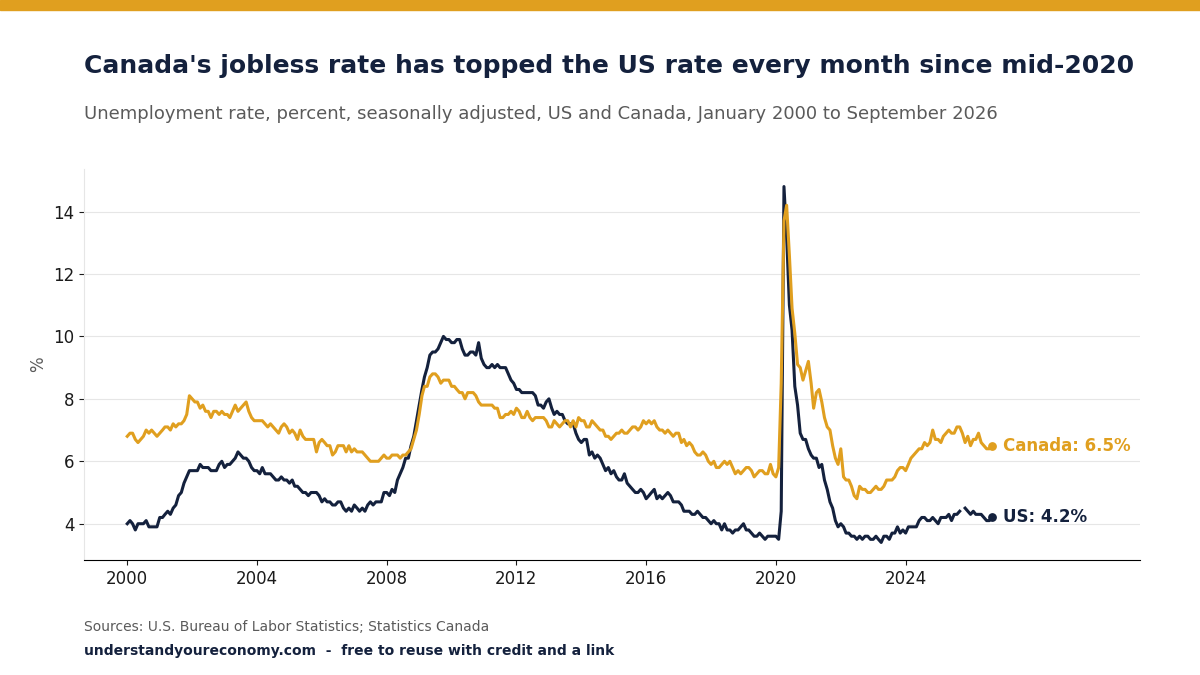
The two countries had very different unemployment rates in September 2026: 4.2% in the US, according to the Bureau of Labor Statistics, and 6.5% in Canada, according to Statistics Canada. The chart above shows Canada's rate has been the higher of the two every month since May 2020, by our reading of both agencies' data.
Who qualifies for unemployment?
You generally qualify if you meet three tests, according to the U.S. Department of Labor:
- The layoff was not your doing. Usually the employer ran short of work and let you go.
- You earned enough in your base period. The base period is usually the first four of the last five completed calendar quarters, so your most recent few months often do not count.
- You meet your state's other rules, such as being able to work and available for a job.
In Canada, the EI test is counted in hours rather than dollars. In 2026 you need 420 to 700 hours of insurable work in the last 52 weeks, depending on the unemployment rate where you live, and at least seven days in a row without work and pay, according to the Government of Canada.
How do you file, and how long does it take to get unemployment?
You file in the state where you worked, and you should file as soon as you are out of work. These are the steps, from the Department of Labor's fact sheet:
- File the claim with the state unemployment agency, online or by phone.
- Wait. The first payment generally arrives two to three weeks after you file, and some states add an unpaid waiting week.
- Claim every week or every two weeks. Each claim confirms you were able to work, available for work and looking for work, and reports any pay you earned or job offers you turned down.
- Keep looking. Missing a claim, or a required meeting, can stop your payments.
In Canada you apply to Service Canada. Applying more than four weeks after your last day of work can cost you benefits, and payments by direct deposit arrive about two business days after your report is processed, according to the Government of Canada. Canada normally keeps the first week unpaid, but that waiting week is waived for claims started from March 30, 2025 to October 9, 2027 under temporary measures.
How much does unemployment pay?
About half of your past pay, up to a cap. In most US states the weekly benefit is a share of what you earned over a recent 52-week period, with a maximum set by the state, the Department of Labor says. In state law effective January 2026, those maximums ranged from $235 a week in Mississippi to $1,152 in Washington, according to the Labor Department's comparison of state laws. Across the US, the average weekly benefit paid in April to June 2026 was $500.61, according to Labor Department data.
The formulas come from the Labor Department's comparison of state laws and the Government of Canada. Our page on how much unemployment you will get works the same paycheck through four state formulas.
How long does unemployment last?
Up to 26 weeks in most US states, according to the Department of Labor, though some states pay fewer. In April to June 2026, people collected for 15.8 weeks on average, and 39.26% used up every week they were allowed, according to Labor Department data. In Canada, regular EI lasts 14 to 45 weeks, according to the Government of Canada.
When unemployment is high, states can switch on Extended Benefits, extra weeks for people who have run out. On October 25, 2026, the number of states paying them was zero, according to the Labor Department's trigger notice. Our page on how long unemployment lasts compares the states.
Can you get unemployment if you quit or are fired?
Quitting usually rules you out, and so does being fired for misconduct. The most common reasons for a denial include leaving a job without good cause and misconduct, which the Department of Labor describes as an act showing "a deliberate disregard of the employer's interests". Being let go because the employer ran out of work is the standard case that qualifies. Canada's EI also turns away people who quit without just cause or lost the job through misconduct, according to the Government of Canada. Both countries let you appeal a denial. Our page on whether you can get unemployment if you quit goes through the rules.
How many unemployed people actually get benefits?
Fewer than you might think. In April to June 2026, 1,714,200 Americans were collecting regular state unemployment benefits, out of 7,120,000 unemployed, according to Labor Department data. That is 24.1%, or about one in four, by our calculation. In Canada, 541,320 people received regular EI in August 2026, out of 1,459,500 unemployed, according to Statistics Canada's EI table and Labour Force Survey. That is 37.1%, by our calculation.
The rest are not all being turned away. The unemployed count includes people who quit, people looking for their first job, people coming back to work after time away, and people whose benefits have run out. In the US, 1.9 million people had been unemployed for 27 weeks or more in September 2026, according to the Bureau of Labor Statistics, longer than most states pay.
How does unemployment work for the employer?
In the US, the employer pays for it, through payroll taxes. The federal unemployment tax is 6.0% of the first $7,000 paid to each worker, but employers get a credit of up to 5.4% for state unemployment tax they pay, leaving 0.6%, or $42 per worker per year, according to the IRS and our calculation. State unemployment taxes come on top: in Massachusetts, for example, employer rates ran from 0.94% to 14.37% in January 2026, according to the Labor Department. Workers do not pay federal unemployment tax.
In Canada, workers and employers both pay EI premiums. In 2026 workers pay 1.63% of insurable earnings up to C$68,900, a maximum of C$1,123.07, and employers pay 1.4 times that, according to the Canada Revenue Agency.
Are unemployment benefits taxed?
Yes, in both countries, under the rules in force in 2026. The IRS counts unemployment compensation as taxable income. The state reports what it paid you on Form 1099-G, and you can ask for federal tax to be withheld with Form W-4V. Most states tax benefits too, according to the Department of Labor. In Canada, EI benefits are taxed in the year you receive them, tax is taken off each payment, and the total appears on a T4E slip, according to the Government of Canada. Our page on whether unemployment is taxable has the details.
How does US unemployment compare with Canada's EI?
| Question | US | Canada |
|---|---|---|
| Who runs it | Each state, under federal rules | The federal government |
| Who pays in | Employers | Workers and employers |
| How you qualify | Enough wages in your base period | 420 to 700 insured hours in 52 weeks |
| Weekly amount | Set by your state; $235 to $1,152 maximum (January 2026) | 55% of average insurable earnings, up to C$729 (2026) |
| How long | Up to 26 weeks in most states | 14 to 45 weeks |
| Waiting period | One week in some states | One week normally; waived for claims from March 30, 2025 to October 9, 2027 |
| Share of unemployed collecting | 24.1% (April to June 2026) | 37.1% (August 2026) |
| Self-employed | Not covered by regular benefits | Special benefits only, such as sickness and parental |
Sources: U.S. Department of Labor fact sheet, Significant Provisions of State UI Laws, January 2026, UI Data Summary, IRS Topic 759, Government of Canada EI eligibility, EI benefit amount, EI temporary measures, EI for self-employed people, Statistics Canada Table 14-10-0011-01. Shares of unemployed collecting are our calculation.
Can self-employed people get unemployment?
Usually not, in either country. Regular US unemployment insurance is paid for by employers, so freelancers, independent contractors and gig workers are generally left out. The one big exception was temporary: Pandemic Unemployment Assistance covered self-employed and gig workers who did not qualify for regular benefits, the Department of Labor announced in April 2020. That program began on March 27, 2020 and ended on September 6, 2021, according to the Labor Department's Office of Inspector General.
In Canada, self-employed people can sign up for EI special benefits, such as sickness, maternity, parental and caregiving benefits, but the Government of Canada lists no regular benefits for them if their work dries up.
What this means for you
- File right away. In both countries a late claim can cost you money, and the first US payment takes two to three weeks to arrive.
- Expect about half your pay, at most. High earners hit the state or EI cap quickly, so the benefit covers a smaller share of their bills.
- Plan for the benefit to end. Most claims stop at 26 weeks or sooner, and in late October 2026 no state was paying extra weeks.
- The benefit is taxable. Setting some aside, or asking for tax to be withheld, avoids a bill the following spring.
How we got these numbers
Most figures on this page are published as-is by the agencies linked next to them. These ones are our own calculations from official data, so you can check them:
- 24.1% of unemployed Americans collected regular benefitsU.S. Department of Labor, April to June 2026: 1,714,200 people on regular state unemployment benefits out of 7,120,000 unemployed. 1,714,200 ÷ 7,120,000 = 0.241, or 24.1%.
- 37.1% of unemployed Canadians collected regular EIStatistics Canada, August 2026: 541,320 people on regular Employment Insurance benefits out of 1,459,500 unemployed. 541,320 ÷ 1,459,500 = 0.371, or 37.1%.
- $42 a year per worker in federal unemployment taxIRS: the federal unemployment tax is 6.0% of the first $7,000 paid to each worker, less a credit of up to 5.4% for state unemployment tax, leaving 0.6%. 0.6% × $7,000 = $42.
We do not adjust the official data, and we make no forecasts of our own.
You are welcome to quote these numbers and charts. Please credit Understand Your Economy and link to this page.
Update log
- : Page created with US Department of Labor data for April to June 2026 and Statistics Canada data for August and September 2026.
Have a question about this article?
Ask us privately. We read every question, reply by email, and the best ones become new answers on the site.
Ask a questionResearched from the official sources linked in this article, drafted and fact-checked by the Understand Your Economy editorial team on October 31, 2026.
This article is general educational information, not personalised financial, investment, tax or legal advice. Consider speaking with a qualified professional about your own situation.
No paid links in this article.
Spotted an error? Tell us and we will correct it.