Explainer
Is unemployment taxable? Federal, state and Canada's EI
- Is unemployment taxable? Yes: the IRS counts benefits as taxable income, and most states tax them too, according to the Department of Labor.
- You can ask for federal tax to be withheld with Form W-4V, or pay quarterly estimated tax; the total paid to you shows on Form 1099-G.
- In Canada, EI benefits are taxed in the year you receive them, with tax taken off each payment, and workers pay EI premiums of up to C$1,123.07 in 2026, according to the Canada Revenue Agency.
Is unemployment taxable? Yes. "Unemployment compensation is taxable income," the Internal Revenue Service says, and most states tax it too, according to the U.S. Department of Labor. In April to June 2026 the average US claim paid $7,486 in benefits per first payment, all of it taxable, according to Labor Department data. In Canada, EI benefits are taxable income in the year you receive them, according to the Government of Canada. Start with how unemployment works.
Is unemployment taxable income on your federal return?
Yes. Under the rules the US Internal Revenue Service published in 2026, unemployment compensation is taxable income, and your state unemployment agency sends you Form 1099-G, Certain Government Payments, showing what it paid you during the year, according to the IRS. If the form does not arrive, the IRS points you to your state agency's website to get it.
Unlike a paycheck, unemployment benefits do not have federal tax taken out unless you ask. The IRS gives two ways to avoid a surprise bill:
- Withholding. Send Form W-4V, Voluntary Withholding Request, to the agency paying you, and it takes federal income tax out of each payment.
- Estimated tax. Make quarterly estimated tax payments yourself.
Is unemployment taxable by your state?
In most states, yes. Benefits are subject to federal income tax and to the income taxes of most states, according to the Department of Labor, and tax can be withheld from your payments. Your state unemployment agency can tell you whether your state taxes them and whether it will withhold.
How much of a claim is taxable?
All of it, at the federal level. In April to June 2026, the average US claim paid $7,486 in benefits from the first payment on, according to Labor Department data. The tax owed depends on your other income for the year, which is why the IRS offers withholding.
Do you pay unemployment tax on your paycheck?
Not in the US, but yes in Canada. The US federal unemployment tax is paid by employers: 6.0% on the first $7,000 paid to each worker, less a credit of up to 5.4% for state unemployment tax, which leaves 0.6%, or $42 per worker a year, according to the IRS and our calculation.
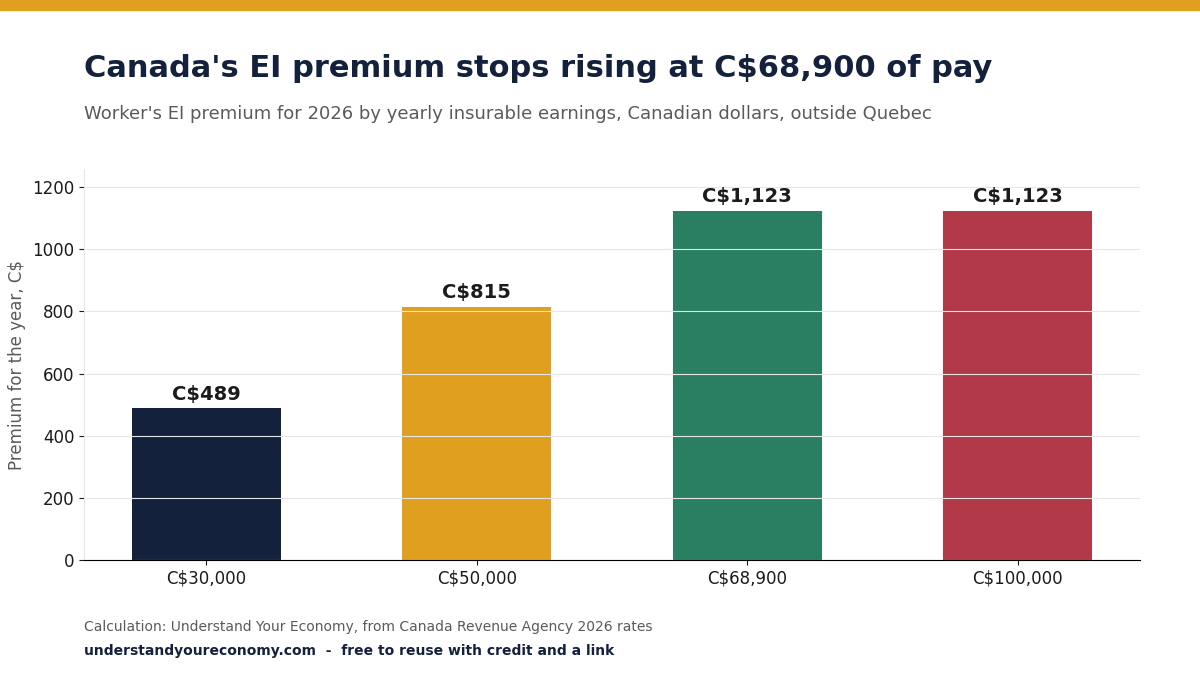
Canadian workers pay EI premiums out of each paycheck. In 2026 the rate is 1.63% of insurable earnings up to C$68,900 outside Quebec, and 1.30% in Quebec, according to the Canada Revenue Agency. Employers pay 1.4 times what their workers pay.
These figures are for workers outside Quebec, using the Canada Revenue Agency's 2026 rates.
Is EI taxable in Canada?
Yes. EI benefits count as income in the year they are paid, federal and provincial income tax is taken off when you receive them, and you get a T4E slip showing the total for your tax return, according to the Government of Canada.
| Question | US | Canada |
|---|---|---|
| Are benefits taxable? | Yes, federal; most states too | Yes, federal and provincial |
| Tax taken off each payment? | Only if you ask (Form W-4V) | Yes |
| Tax slip | Form 1099-G | T4E |
| Do workers pay into the program? | No federal tax on workers | Yes, 1.63% up to C$68,900 in 2026 (1.30% in Quebec) |
| Employer's share | 0.6% of the first $7,000 federal, after the state credit, plus state tax | 1.4 times the worker's premium |
Sources: IRS, unemployment compensation, IRS Topic 759, U.S. Department of Labor fact sheet, Government of Canada, EI tax slips, Canada Revenue Agency, 2026 EI rates.
What this means for you
- In the US, nothing is withheld unless you ask. Without Form W-4V or estimated payments, the tax on your benefits comes due the following spring (IRS, 2026).
- Keep the tax slip. Form 1099-G in the US and the T4E in Canada carry the totals for your return.
- Benefits are already smaller than pay. Tax takes a further share, so the weekly amount on our page about how much unemployment you will get overstates what you keep.
- Plan for the whole claim. Tax applies to every week you collect; our page on how long unemployment lasts shows how many weeks that can be.
How we got these numbers
Most figures on this page are published as-is by the agencies linked next to them. These ones are our own calculations from official data, so you can check them:
- C$1,123.07 maximum EI premium for a worker in 2026Canada Revenue Agency, 2026: workers outside Quebec pay 1.63% of insurable earnings up to C$68,900. 1.63% × C$68,900 = C$1,123.07.
- $42 a year per worker in US federal unemployment taxIRS: 6.0% of the first $7,000 paid to each worker, less a credit of up to 5.4% for state unemployment tax, leaves 0.6%. 0.6% × $7,000 = $42, paid by the employer.
We do not adjust the official data, and we make no forecasts of our own.
You are welcome to quote these numbers and charts. Please credit Understand Your Economy and link to this page.
Update log
- : Page created with IRS, Department of Labor, Government of Canada and Canada Revenue Agency rules for 2026.
Have a question about this article?
Ask us privately. We read every question, reply by email, and the best ones become new answers on the site.
Ask a questionResearched from the official sources linked in this article, drafted and fact-checked by the Understand Your Economy editorial team on October 31, 2026.
This article is general educational information, not personalised financial, investment, tax or legal advice. Consider speaking with a qualified professional about your own situation.
No paid links in this article.
Spotted an error? Tell us and we will correct it.