Explainer
How long does unemployment last? Weeks by state and EI
- How long unemployment lasts depends on the state: up to 26 weeks in most states, but 12 at most in Florida and Arkansas and up to 30 in Massachusetts, under state laws effective January 2026 compiled by the U.S. Department of Labor.
- US claimants collected for 15.8 weeks on average in April to June 2026, and 39.26% used every week they were allowed, according to Labor Department data.
- Canada's regular EI lasts 14 to 45 weeks, according to the Government of Canada, and up to 65 weeks for long-tenured workers on claims started from June 15, 2025 to June 12, 2027.
How long does unemployment last? Up to 26 weeks in most US states, according to the U.S. Department of Labor, but some states stop sooner: 12 weeks at most in Florida and Arkansas under laws effective January 2026, according to the Labor Department's comparison of state laws. In Canada, regular EI lasts 14 to 45 weeks, according to the Government of Canada. Start with how unemployment works if you are new to it.
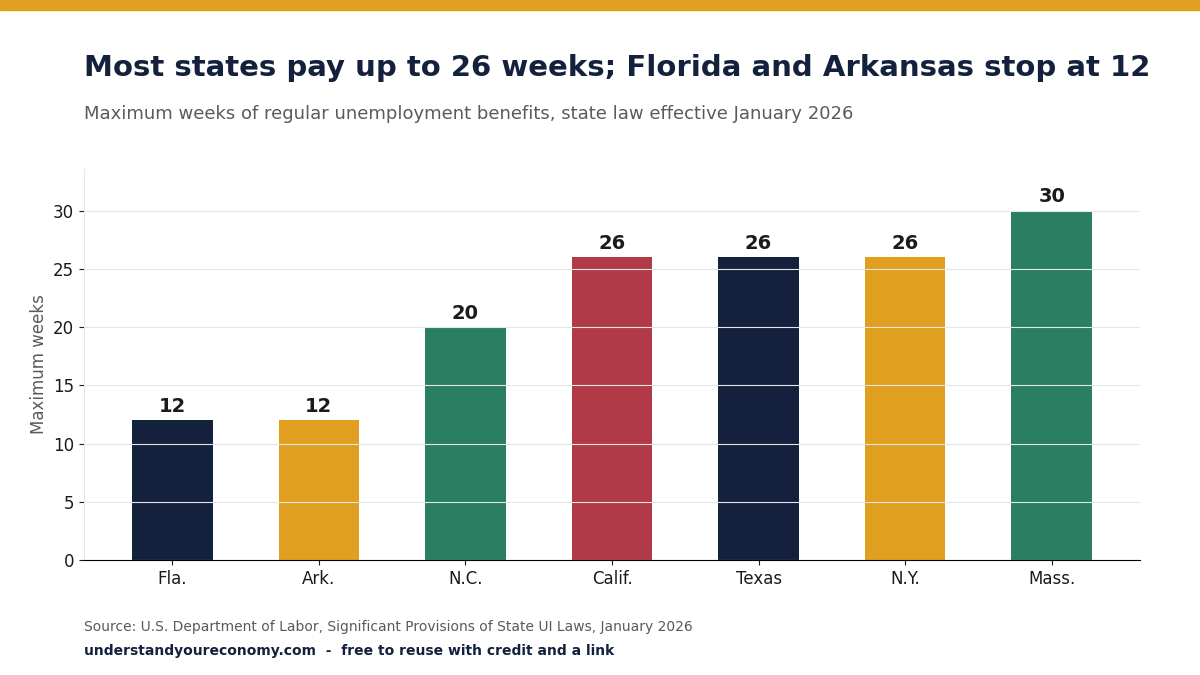
How many weeks of unemployment can you get in each state?
Each state law sets a range of weeks. These are the ranges in nine states, effective January 2026, from the Labor Department's comparison of state laws:
| State | Weeks of regular benefits |
|---|---|
| Florida | 9 to 12 |
| Arkansas | 9 to 12 |
| North Carolina | 12 to 20 |
| Texas | 10 to 26 |
| Mississippi | 13 to 26 |
| California | 14 to 26 |
| Washington | 1 to 26 |
| New York | 26 |
| Massachusetts | 10 to 30 |
Sources: U.S. Department of Labor, Significant Provisions of State UI Laws, January 2026. The ranges leave out extra weeks paid in times of high unemployment.
How long does unemployment last in New York? New York's law sets 26 weeks, the same as the maximum in California and Texas, according to the Labor Department's January 2026 table.
In Florida the number of weeks also moves with the state's unemployment rate, so the maximum can change from one year to the next, according to the same Labor Department table. Florida and Arkansas also pay low weekly amounts, as our page on how much unemployment you will get shows.
How long do people actually stay on unemployment?
Shorter than the maximum, on average. In April to June 2026, US claimants collected for 15.8 weeks on average, according to Labor Department data. That is 10.2 weeks short of a 26-week claim, by our calculation. The same data show that 39.26% of claimants used up every week they were allowed, which means 60.74% stopped before reaching their limit, by our calculation.
Running out is a real risk for people who stay jobless longer. In September 2026, 1.9 million people in the US had been out of work for 27 weeks or longer, according to the Bureau of Labor Statistics. That is longer than regular benefits last in most states.
What happens when unemployment runs out?
In the US, regular benefits stop, and you can only get more if your state has switched on Extended Benefits. They may be available during periods of high unemployment, according to the Department of Labor. On October 25, 2026, no state had them switched on, according to the Labor Department's trigger notice.
How long does unemployment last in Canada?
Regular EI lasts 14 to 45 weeks. The number depends on how many insurable hours you worked and on the unemployment rate in your region, according to the Government of Canada.
Canada has also added weeks for some workers under temporary measures. Workers the government classes as long-tenured get up to 20 extra weeks, to a maximum of 65 weeks, on claims started from June 15, 2025 to June 12, 2027.
| Measure | US | Canada |
|---|---|---|
| Usual maximum | 26 weeks in most states | 14 to 45 weeks, by region and hours |
| Shortest maximum | 12 weeks (Florida, Arkansas) | 14 weeks |
| Longest maximum | 30 weeks (Massachusetts) | 45 weeks, or 65 for long-tenured workers |
| Extra weeks in hard times | Extended Benefits; zero states on October 25, 2026 | Temporary measures to June 12, 2027 |
| Average weeks used | 15.8 (April to June 2026) | Not published on the same basis |
Sources: U.S. Department of Labor fact sheet, Significant Provisions of State UI Laws, January 2026, UI Data Summary, 2nd quarter 2026, trigger notice 2026-41, Government of Canada, EI benefit amount, EI temporary measures.
What this means for you
- Know your state's maximum on day one. In a 12-week state, the money runs out in about three months.
- Claim every week. Weekly or every-two-weeks claims are what keep the payments coming.
- Do not count on extra weeks. Extended Benefits switch on only when a state's unemployment is high, and none were on in late October 2026.
- Canada's limits depend on where you live. The number of EI weeks moves with your region's unemployment rate as well as your hours.
How we got these numbers
Most figures on this page are published as-is by the agencies linked next to them. These ones are our own calculations from official data, so you can check them:
- Up to 65 weeks of EI for long-tenured workersGovernment of Canada: regular EI lasts up to 45 weeks, and long-tenured workers on claims started from June 15, 2025 to June 12, 2027 get 20 more weeks. 45 + 20 = 65 weeks.
- 60.74% of US claimants stopped before running outU.S. Department of Labor, April to June 2026: the exhaustion rate, the share of claimants who used every week they were allowed, was 39.26%. 100% − 39.26% = 60.74% stopped earlier.
We do not adjust the official data, and we make no forecasts of our own.
You are welcome to quote these numbers and charts. Please credit Understand Your Economy and link to this page.
Update log
- : Page created with state laws effective January 2026 and Labor Department data for April to June 2026.
Have a question about this article?
Ask us privately. We read every question, reply by email, and the best ones become new answers on the site.
Ask a questionResearched from the official sources linked in this article, drafted and fact-checked by the Understand Your Economy editorial team on October 31, 2026.
This article is general educational information, not personalised financial, investment, tax or legal advice. Consider speaking with a qualified professional about your own situation.
No paid links in this article.
Spotted an error? Tell us and we will correct it.