Explainer
How much is inflation costing your savings?
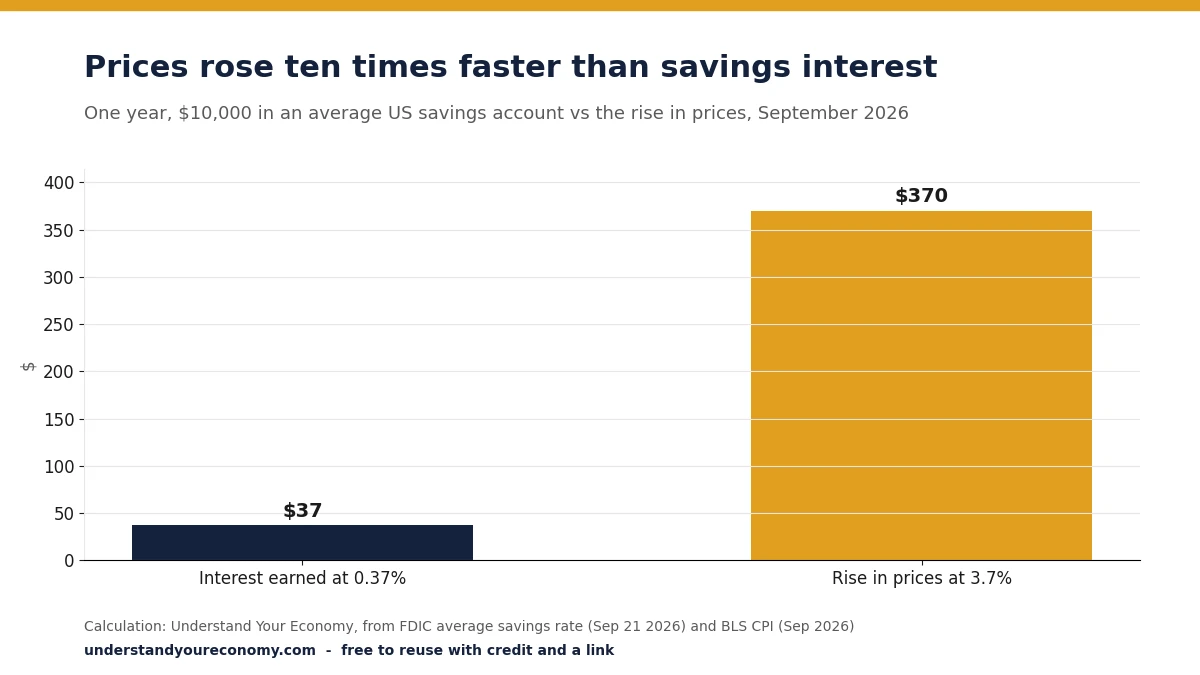
Inflation costs your savings the difference between what your money earns and how fast prices rise. In the US, the national average savings account paid 0.37% as of September 21, 2026, according to the FDIC, while prices rose 3.7% over the 12 months to September 2026. See our guide to inflation for how prices are measured.
Why does money in savings lose value?
Inflation raises the price of what your money can buy. Interest raises the number of dollars you have. When the interest rate is lower than inflation, prices win, and each year your savings buy a little less.
Economists call this a negative real return. In September 2026 the real return on an average US savings account was roughly minus 3.3% a year: the 0.37% interest rate minus 3.7% inflation, based on FDIC and Bureau of Labor Statistics figures.
How do other US savings rates compare?
Some US government products paid well above the average savings account in 2026. On October 15, 2026, 13-week Treasury bills paid 4.20%, according to the U.S. Treasury. Series I savings bonds issued from May 1 to October 31, 2026 paid 4.26%, according to TreasuryDirect. These are general rates, not a recommendation; each product has its own rules on access and limits.
What this means for you
- Check the rate your savings earn against the latest inflation figure on our inflation tracker.
- A rate below inflation means your money is shrinking, even if the balance goes up.
- To see how fast the damage adds up over years, read about the rule of 72.
Researched from the official sources linked in this article, drafted and fact-checked by the Understand Your Economy editorial team on October 16, 2026.
This article is general educational information, not personalised financial, investment, tax or legal advice. Consider speaking with a qualified professional about your own situation.
No paid links in this article.
Spotted an error? Tell us and we will correct it.